
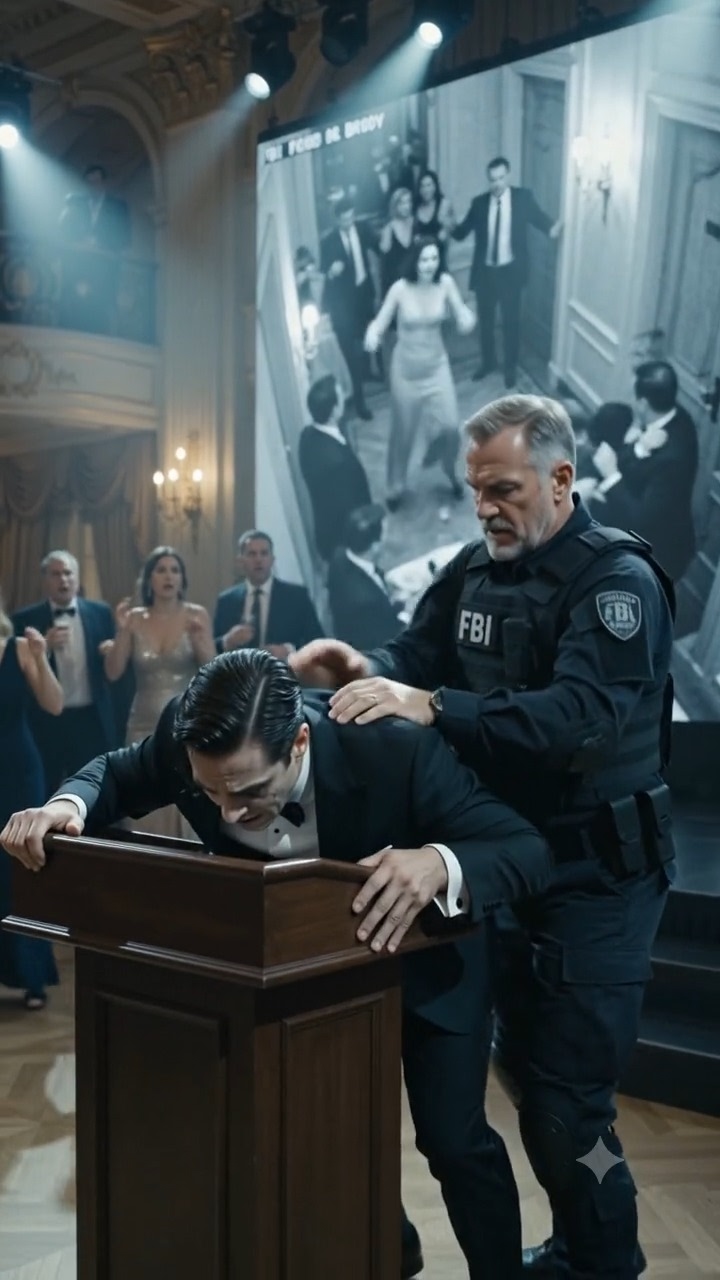
Chapter 4: The General Court-Martial
The courtroom at Fort Meade was stark, cold, and imposing. Unlike the warm wood paneling of the county family court, this military tribunal chamber felt like a place built specifically for judgment.
High rank filled the room. Officers in immaculate uniforms sat in the gallery, their faces grave. The military community took betrayal from within its ranks as a personal insult, and Captain Ryan Mitchell’s case had sent shockwaves through the entire base.
I sat in the front row of the gallery, wearing a tailored charcoal suit. Beside me sat my legal advocate from the Special Victims’ Counsel.
When the side doors opened, two armed Military Police officers escorted Ryan into the room.
The transformation was staggering.
The polished, arrogant hero who had strutted into the civil court a week ago was gone. Ryan was wearing an unadorned service uniform—his medals, ribbons, and officer badges had been stripped away per regulations for court-martial defendants. His hair was messy, his eyes were sunken and bloodshot, and he walked with a slight slouch, his hands cuffed in front of him until he reached the defense table.
Sitting beside him was his court-appointed military defense attorney, Major Sandra Lee. She looked exhausted, clearly aware that she was representing a man with zero defense left.
Behind the prosecution table stood the trial counsel, Colonel Vance, looking like a statue of justice.
“All rise,” the bailiff announced as the military judge, Colonel James Sterling, entered the room.
We all stood up in unison. Colonel Sterling took his seat behind the elevated bench, his piercing gaze sweeping over the courtroom before settling on Ryan.
“Captain Ryan Mitchell,” Colonel Sterling began, his voice echoing off the concrete walls. “You stand before this General Court-Martial charged with multiple violations of the Uniform Code of Military Justice: Article 121, Larceny; Article 132, Fraud Against the United States; Article 133, Conduct Unbecoming an Officer; and Article 134, Witness Tampering and Obstruction of Justice. How do you plead?”
Major Lee stood up beside Ryan. She turned to him, whispering something softly. Ryan stared straight ahead, his chest rising and falling heavily.
“Your Honor,” Major Lee spoke, her voice steady. “My client wishes to enter a plea of guilty to all charges pursuant to a pre-trial agreement.”
A quiet murmur ran through the gallery. Ryan wasn’t even fighting. He knew the paper trail was airtight, the wiretaps were undeniable, and the child’s testimony had utterly destroyed his credibility.
“Captain Mitchell,” Colonel Sterling asked, leaning forward. “Do you understand that by pleading guilty, you waive your right to a full trial by panel? Do you understand that a guilty plea is an admission that you committed these crimes knowingly and with full intent?”
Ryan cleared his throat, his voice raspy and broken. “Yes, Your Honor. I understand.”
“Before I accept your plea and pass sentence,” Colonel Sterling said, “the victim in this case, Mrs. Sarah Mitchell, has requested to deliver a Victim Impact Statement. Mrs. Mitchell, you may step forward.”
My heart pounded, but my hands didn’t shake. I stood up from my seat, pulled a single folded piece of paper from my jacket pocket, and walked slowly to the podium facing the judge and the defense table.
Ryan refused to look at me at first. He kept his head bowed, staring at his cuffed hands.
“Look at her, Captain,” Colonel Sterling ordered coldly from the bench. “Show the court at least that much respect.”
Slowly, reluctantly, Ryan turned his head to face me.
I looked into the eyes of the man I had once sworn to love forever. The anger I had carried for months wasn’t there anymore. In its place was a profound, quiet clarity.
“Ryan,” I began, my voice clear and ringing through the silence of the military court. “When you took your oath as an officer, you swore to support and defend the Constitution, to bear true faith and allegiance, and to take your obligation freely without mental reservation. And when you married me, you made a vow to protect our family.”
Ryan swallowed hard, a flicker of pain crossing his features.
“You failed both oaths,” I continued, holding his gaze. “You took the power, authority, and trust given to you by the United States Army and used it to steal from your fellow soldiers. You took the love and trust of your family and used it to manipulate, gaslight, and financially ruin us. But your greatest crime wasn’t the money you stole or the affair you hid.”
I leaned closer to the microphone.
“Your greatest crime was trying to turn our seven-year-old son into an accomplice to your evil,” I said, my voice hardening into steel. “You told Noah that love meant lying. You told him that protecting his father meant destroying his mother. You tried to break his little heart to save your own skin.”
I glanced up at the judge, then back at Ryan.
“Noah saluted the judge in that civil court not because you trained him to be a soldier for your lies,” I said softly. “He saluted because he is a true protector. He protected me. He protected the truth. He has more honor in his little finger than you ever had in your entire career.”
A heavy silence filled the courtroom. I saw a tear spill over Ryan’s eye, rolling down his cheek, but there was no sympathy left in me for him.
“I hope that during your years in prison,” I concluded, folding my paper, “you think about the boy you tried to corrupt. And I hope you realize that despite everything you tried to take from us… you failed. Noah and I are free. And you are finally exposed for exactly what you are.”
I turned away from the podium and walked back to my seat, stepping with purpose and grace.
Colonel Sterling cleared his throat. “Captain Ryan Mitchell. For your actions, which bring dishonor upon the United States Armed Forces, this court sentences you as follows:”
The judge stood up, and everyone in the courtroom stood with him.
“You are sentenced to be reduced in rank to Private E-1,” Colonel Sterling announced firmly. “You are sentenced to forfeit all pay and allowances. You are sentenced to receive a Dishonorable Discharge from the United States Army. And you are sentenced to confinement at the United States Disciplinary Barracks at Fort Leavenworth for a period of twenty-two years.”
Bang.
The judge’s gavel struck the wood with absolute finality.
The MPs immediately moved in, pulling Ryan’s arms behind his back and snapping heavy steel handcuffs around his wrists. They turned him around to lead him out through the side exit—the door reserved for convicts.
As Ryan was led away, he looked back at me one last time. His face was a mask of utter defeat. The doors clicked shut behind him, closing the chapter on Captain Ryan Mitchell forever.
Orther Post



Behind the Uniform, Stolen Honor: The Military Wife's Revenge
6
Chapters