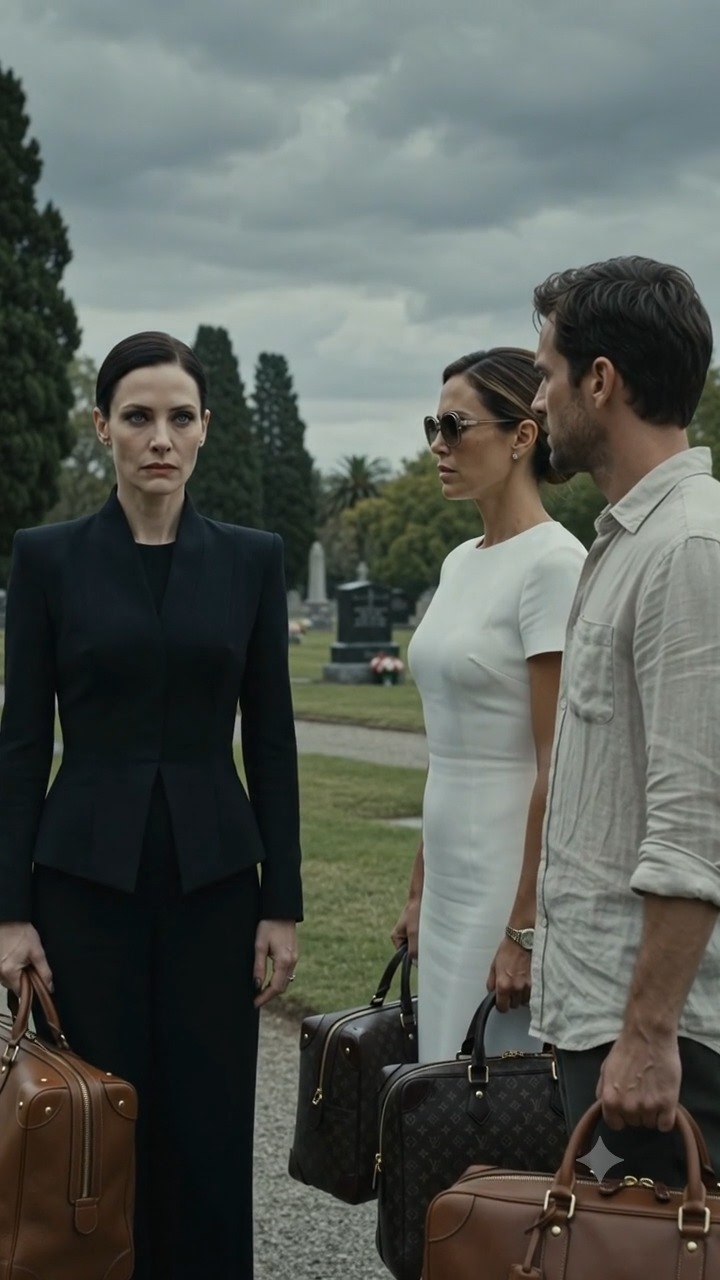
CHAPTER 4: THE TRIBUNAL OF JUSTICE
Six months later.
The United States Federal District Court in San Jose was packed to maximum capacity. Journalists from The Wall Street Journal, Bloomberg, Forbes, and The New York Times occupied every single wooden bench in the gallery.
At the defense table sat Julian Vance.
The six months had aged him by fifteen years. His hair was streaked with gray, his face was gaunt, and he wore an ill-fitting, off-the-rack navy suit purchased from a department store—a stark departure from his former tailored Italian wardrobe. Beside him sat a court-appointed public defender, as his private legal defense team had resigned months ago after Julian’s credit cards were declined and his corporate assets were completely liquidated to satisfy court judgments.
Across the room, at the prosecution table, sat the lead attorneys for the Securities and Exchange Commission, flanked by representatives from the Department of Justice.
I sat in the front row of the gallery, wearing a bespoke ivory silk blouse and tailored charcoal trousers. Marcus Vance sat beside me, reviewing the final settlement distribution documents.
The honorable Judge Rebecca Vance (no relation to Marcus) tapped her wooden gavel twice, bringing the courtroom to absolute order.
“Case number CR-2026-8894,” Judge Vance announced, her voice echoing off the high marble walls. “The United States versus Julian Vance. Counts including Securities Fraud under the Sarbanes-Oxley Act, Wire Fraud, Aggravated Falsification of Corporate Assets, and Intentional Breach of Fiduciary Obligations.”
Judge Vance looked over her half-moon spectacles at Julian, who stood up with his defense attorney, trembling visibly.
“Mr. Vance,” Judge Vance said severely. “Over the course of this six-month federal investigation, this court has reviewed thousands of pages of internal communications, financial transactions, and expert testimony regarding your conduct at Vanguard Analytics. The evidence demonstrates a calculated, arrogant, and pervasive pattern of corporate deceit.”
She turned a page on her dossier.
“You systematically misrepresented the ownership of primary intellectual property to institutional investors, raising tens of millions of dollars on false pretenses. You attempted to sell a $500 million public tech conglomerate an asset that you knew, or reasonably should have known, was exclusively owned by an independent holding entity, Aegis Innovations LLC. Furthermore, when confronted with your actions, you attempted to intimidate and illegally disenfranchise the true inventor, Ms. Maya Lin.”
Julian looked down at the defense table, his shoulders slumped in total defeat.
“Pursuant to the plea agreement submitted by the prosecution,” Judge Vance continued, “and taking into account the complete liquidation of Vanguard Analytics’ remaining corporate assets to partially satisfy the $75 million civil judgment awarded to OmniTech Industries and private equity investors… I sentence you, Julian Vance, to a period of eight years and six months in federal custody at the Lompoc Federal Correctional Institution, followed by three years of supervised release.”
A loud whisper swept through the press gallery as reporters frantically typed on their laptops.
“In addition,” Judge Vance added, “a restitution order of $42 million is hereby leveled against you personally. All remaining personal assets, including real estate, luxury vehicles, and liquid holdings, are forfeited to the bankruptcy trustee for distribution to creditors and your former spouse, Ms. Maya Lin, pursuant to the settled divorce decree.”
Gavel slam.
“Court is adjourned.”
Two federal marshals stepped forward, grabbed Julian’s arms, and clicked heavy steel handcuffs around his wrists. As they turned him around to lead him through the side door to the holding cells, Julian’s eyes caught mine.
There was no anger left in his eyes. There was no arrogance. There was only an overwhelming, hollow void of regret. He looked at me, his mouth opening slightly as if he wanted to say one final word, but no sound came out.
I didn’t look away. I didn’t smile. I didn’t feel a surge of malicious joy. I simply watched him go—a ghost of my past being led away into the dark hallway of accountability.
As the marshals led Julian through the heavy steel door, Serena walked out of the gallery court room through the rear exit, accompanied by her criminal attorney. Though she had managed to avoid prison time by turning state’s evidence against Julian early in the SEC investigation, her career in Silicon Valley was completely dead. Her name had become synonymous with corporate toxicity, and every major executive recruitment firm in California had officially blacklisted her.
Marcus Vance leaned over to me, closing his briefcase with a satisfying snap.
“Well, Maya,” Marcus said with a subtle smile. “That brings an official end to the chapter of Vanguard Analytics. How does it feel?”
I turned away from the defense table and looked out the window at the sunny California sky.
“It feels like the administrative work is finally done,” I said calmly. “Now, I can get back to building.”
Orther Post