
PART 2 — THE PRECINCTS OF GLASS AND IRON
Captain Thomas Landry’s eyes did not drop immediately to the leather wallet in my hand; instead, they flared with the practiced arrogance of a man who had dictated reality within a thirty-mile radius for twenty-four years. He looked at my face, searching for the girl who used to sit at the end of the Thanksgiving table, quietly passing the gravy while her brother bragged about his real estate commissions.
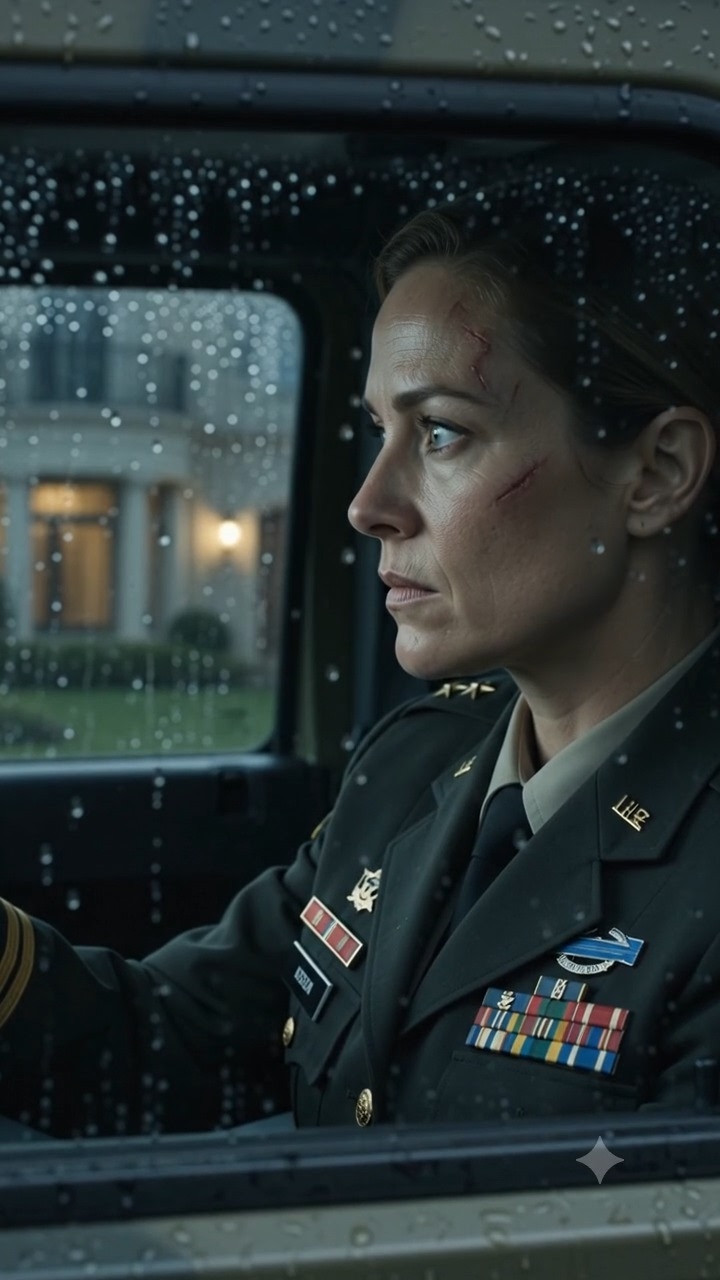
He saw neither. He saw six feet of standing posture honed by six deployments, a jaw set like concrete, and the cold, unblinking grey eyes of a senior field commander who had dismantled a rogue contracting ring in Fallujah before he had ever heard the name Brooke Landry.
“Clara?” Arthur’s voice broke from behind the desk. It was thin, reedy, wet with confusion. He took a half-step forward, his designer loafers squeaking against the wet linoleum floor. “Clara, what the hell are you wearing? What is this? Why are you—”
“Silence, civilian,” I said.
My voice didn’t rise. It didn’t need to. It carried the specific frequency of an order given on a active flight line—low, resonant, carrying the absolute expectation of instant, unthinking obedience. Arthur froze mid-stride, his mouth hanging open like an unhinged trapdoor.
“Clara, don’t talk to my husband like that!” Brooke snapped, her voice instantly dropping the delicate, hyperventilating tone she’d used for the desk sergeant two minutes prior. She straightened up, her French manicure digging into Arthur’s forearm. “Thomas, tell her to get out! She’s intruding on a domestic violence investigation! She can’t just—”
“Brooke,” Captain Landry said quietly. His voice had lost its thunder. The four silver bars on his collar seemed suddenly very heavy, pulling his neck down a fraction of an inch. “Be quiet.”
“What? Uncle Tom, she’s—”
“I said shut your mouth, Brooke!” Landry barked, his face turning the color of a bruised plum. He turned back to me, taking a heavy step forward, trying to use his belly and his broad shoulders to fill the hallway. “Colonel… or whatever title you’re playing with tonight. You’re out of your jurisdiction. This is the town of Westbridge. Municipal property. State law. You have no authority over a local domestic dispute, and you sure as hell don’t have authority over my officers.”
I let out a slow breath through my nose. I reached into my inner jacket pocket, pulled out a thick, black leather folder bound with yellow federal security tape, and held it out. I didn’t hand it to him. I held it at eye level, just close enough for him to read the top line of the seal: Department of Defense Joint Public Corruption Task Force — Operation Iron Sweep.
“Read the small print at the bottom, Captain,” I said softly. “The one right under the signature of the Assistant Attorney General for the Civil Rights Division.”
Landry squinted. His head leaned forward half an inch.
“Pursuant to Title 18, United States Code, Sections 241 and 242,” I read for him, standardizing my tone into the dead-flat rhythm of a federal indictment. “And executed under the emergency provisions of the Posse Comitatus Authorization Amendment of 2022 regarding federal funds utilized by municipal law enforcement agencies. As of 0100 hours this morning, Westbridge Police Department fell under federal oversight due to preliminary findings of systemic evidence suppression, civil rights violations under color of authority, and racketeering.”
I took a step closer to him, closing the space until I could smell the stale coffee and cheap cigars on his breath.
“You’re not under my jurisdiction, Captain. You’re under my boot. And five minutes ago, your officers committed three federal felonies in my presence while executing an unlawful arrest of a federal witness.”
Landry’s chest heaved. He looked at the desk sergeant. The sergeant was no longer looking at either of us; he was staring intently at his blotter, his hands flat on the desk, trembling so hard the plastic pen holder was vibrating against the wood.
“Sergeant Miller,” Landry said, his voice tightening. “Call the District Attorney. Right now. Get Dan on the phone.”
“Sergeant Miller,” I said, not turning my head. “If you touch that desk phone, I will have the two Deputy US Marshals sitting in the unmarked Suburbans outside come through those double doors and place you in federal custody for aiding and abetting an ongoing obstruction of justice. You will be processed at the federal courthouse in Newark before sunrise. You will not see your family before Monday.”
Sergeant Miller’s hand, which had been creeping toward the heavy black receiver, recoiled as if the plastic were red-hot. He pulled his hands back into his lap and sat rigidly, staring straight ahead.
“You’re bluffing,” Brooke hissed, though her chin was beginning to quiver. She looked between her uncle and me, her perfectly filled lips turning white. “Arthur, tell her! Tell her she can’t do this! This is my uncle’s station! She’s just a… she’s just an administrator! She sits at a desk in Virginia!”
I ignored her completely. I looked down at my mother.
Professor Helena Carter was sitting on the hard wooden bench, her left arm clutched tightly against her ribs. Her face was pale, grayed by pain and shock, but her right eye—the one that wasn’t swollen shut—was clear. She was watching me with an expression I hadn’t seen since I was seven years old and had come home with a bloody knee after standing up to the neighborhood bully: a mix of profound relief and fierce, quiet pride.
“Mom,” I said, dropping to one knee again, my knee resting on the filthy tile floor without a thought for my dress uniform trousers. “Can you walk?”
“I… I think so, Clara,” she whispered. Her voice was cracked, raw from crying into the dark corner of a locked bathroom. “My wrist… it feels like loose gravel.”
“We’re going to fix it,” I said. “Right now.”
I stood up, turned around, and faced the four patrol officers standing near the water cooler.
“Key,” I said, extending my hand toward the nearest rookie—the one who had removed his wedding ring moments earlier.
The boy looked at Landry. Landry didn’t move. He stood frozen, a statue of a dying kingdom, his jaw clenched so hard his cheek muscles were twitching.
“Key. Now. Before I add deprivation of medical care to your personal charge sheet, Officer… Vance,” I said, reading his silver nameplate. “Do you know what twenty years in a federal penitentiary does to a kid who looks like you? The federal system doesn’t have parole, Vance. You serve eighty-five percent. Minimum.”
Officer Vance reached into his belt with fingers that were shaking uncontrollably. He pulled out the small, brass cuff key, dropped it twice, picked it up off the floor, and practically dropped it into my open palm.
“Thank you,” I said.
I turned back to my mother, inserted the key, and clicked the cuffs open. The steel unlatched with a loud, sharp clack that echoed off the high ceiling of the lobby.
My mother let out a jagged gasp as her hands came free. She immediately cradled her left arm against her stomach. I reached into my coat, pulled out my heavy silk military scarf, and expertly folded it into a temporary sling, securing her arm against her chest with minimal movement.
“Arthur,” I said, turning slowly to my brother.
Arthur flinched. He was thirty-six years old, three years younger than me, wearing a five-hundred-dollar fleece vest and Italian leather loafers. He looked like an advertisement for a suburban lifestyle that had suddenly gone rotten from the core.
“Clara, look,” Arthur stammered, holding his hands up defensively. “You don’t understand the whole story. Mom was… she was being unreasonable. She came over to the house at midnight, screaming about—”
“Arthur,” I interrupted. “When was the last time Mom weighed herself?”
He blinked. “What? What kind of question is that? I don’t—”
“She weighs one hundred and twelve pounds,” I said, my voice dropping an octave, becoming cold as ice. “She is seventy-one years old. She has osteoporosis in her left hip. Brooke weighs one hundred and sixty pounds and played Division II softball for three years.”
Brooke gasped, taking a step back behind Arthur.
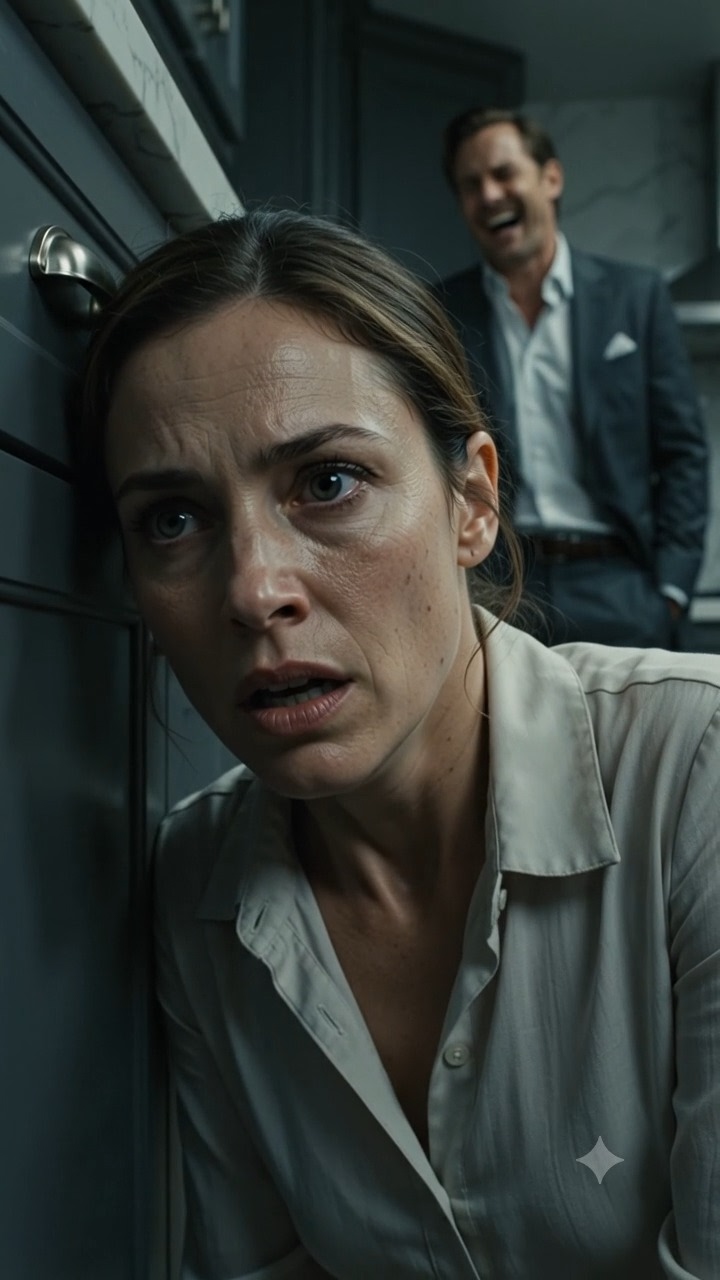
“You stood in your own kitchen,” I continued, taking a step toward my brother until I was standing so close he had to tilt his head back to look me in the eye. “You stood there and watched a woman half your mother’s size—the woman who worked two jobs to pay for your college tuition, who wrote your cover letters when you failed the bar exam twice—you watched your wife hit her with a wooden bat. And then you called your wife’s corrupt uncle to drag your mother away so you wouldn’t have to look at the bruises.”
“She threatened to cut us off!” Brooke screamed, her face contorting into a mask of pure fury, abandoning all pretense of the victim. “She threatened to change her trust! She said she was giving the lake house to the university scholarship fund! She had no right! That house belongs to Arthur’s children!”
The entire lobby was dead silent. The officers weren’t looking at Brooke; they were looking at the floor, at the walls, anywhere but at the confession that had just erupted from her mouth.
I looked at Landry. “Did you record that, Captain? Because my body harness has been transmitting audio to the regional office since I walked through those doors.”
Landry’s face drained completely white. His hand twitched toward his holster—a purely instinctual, panicked gesture.
“I wouldn’t,” I said softly.
The heavy front doors of the station burst open.
Four men walked in. They didn’t wear uniforms; they wore dark suit trousers, tactical boots, and heavy windbreakers with gold lettering across the back: U.S. MARSHALS.
The lead agent, a six-foot-four veteran named Jackson with a graying beard and a scar across his left eyebrow, scanned the lobby in half a second. He held a thick stack of blue-paper federal warrants in his hand.
“Colonel Carter,” Jackson said, acknowledging me with a sharp nod. “Perimeter is secure. The state police escort for the ambulance is two minutes out.”
“Good timing, Agent Jackson,” I said, turning my back on Landry. “Take possession of the evidence locker immediately. Specifically, look for a thirty-two-inch Louisville Slugger bat with fresh blood on the barrel. It was returned to the suspect, Brooke Landry-Carter, approximately forty-five minutes ago.”
“Hey! You can’t search my house without a warrant!” Brooke shrieked, backing into the wall.
Agent Jackson smiled—a slow, terrifying grin that showed too many teeth. He raised the stack of blue papers.
“Signed by Federal Magistrate Judge Vance at 0245 hours, ma’am,” Jackson said. “We have a search warrant for your residence, your vehicles, your personal cell phones, and Captain Landry’s private office in this building.”
Landry took a step back, reaching for his desk phone again, but Jackson’s deputy was already behind him. In one smooth, practiced motion, the deputy stepped between Landry and the desk, unclipped his cuffs, and looked at me for the word.
“Not yet,” I told the deputy. “Let him watch.”
I turned back to my mother, gently sliding my arm under her good shoulder to help her stand. “Mom, the ambulance is here. We’re going to the medical center.”
“Clara…” Mom whispered, her hands shaking as she held my sleeve. “Your brother…”
“Arthur made his choice three hours ago, Mom,” I said gently. “Now he gets to live with it.”
As I led my mother toward the double doors, Arthur made a desperate leap forward, snatching at my jacket sleeve. “Clara! Please! You can’t do this to us! I’m your brother! We’re family!”
I stopped. I didn’t turn around immediately. I slowly peeled his fingers off my sleeve, one by one, with enough pressure to force him to his knees.
“Family doesn’t leave their mother to bleed in a cell, Arthur,” I whispered, leaning down so only he could hear me. “Brooke wanted the lake house. Now she can share a twelve-by-eight room with a roommate for the next fifteen years. And as for you…”
I looked up at Agent Jackson.
“Agent Jackson, Mr. Carter is a material witness to an aggravated assault and an active co-conspirator in a federal obstruction investigation. Secure him.”
“No! Clara! NO!” Arthur screamed as the second deputy stepped forward, pulled Arthur’s arms behind his back, and snapped the steel cuffs around his wrists. Brooke began to scream high-pitched, hysterical insults, her polished facade completely shattered as she was pinned against the wall by a female marshal.
I pushed open the double doors of the precinct.
The rain was still pouring, but the red and blue flashes of the incoming ambulance and state police cruisers lit up the night sky, casting long, sharp shadows across the wet asphalt.
My mother looked up at the flashing lights, then at me.
“Where are we going, Clara?” she asked, her voice small, exhausted, but no longer afraid.
“First, the hospital,” I said, opening the door of the waiting ambulance as the paramedics rushed forward with a gurney. “And then, Mom… we’re going to clean house.”
Orther Post


2:27 A.M.: THE COLONEL'S REVENGE
5
Chapters