

Chapter 4: The Reckoning
The television studio was lit with blinding white lights that reminded me of the operating room. Sitting opposite me was Sarah Jenkins, the state’s top investigative journalist. She looked at me with a mixture of professional intensity and deep respect.
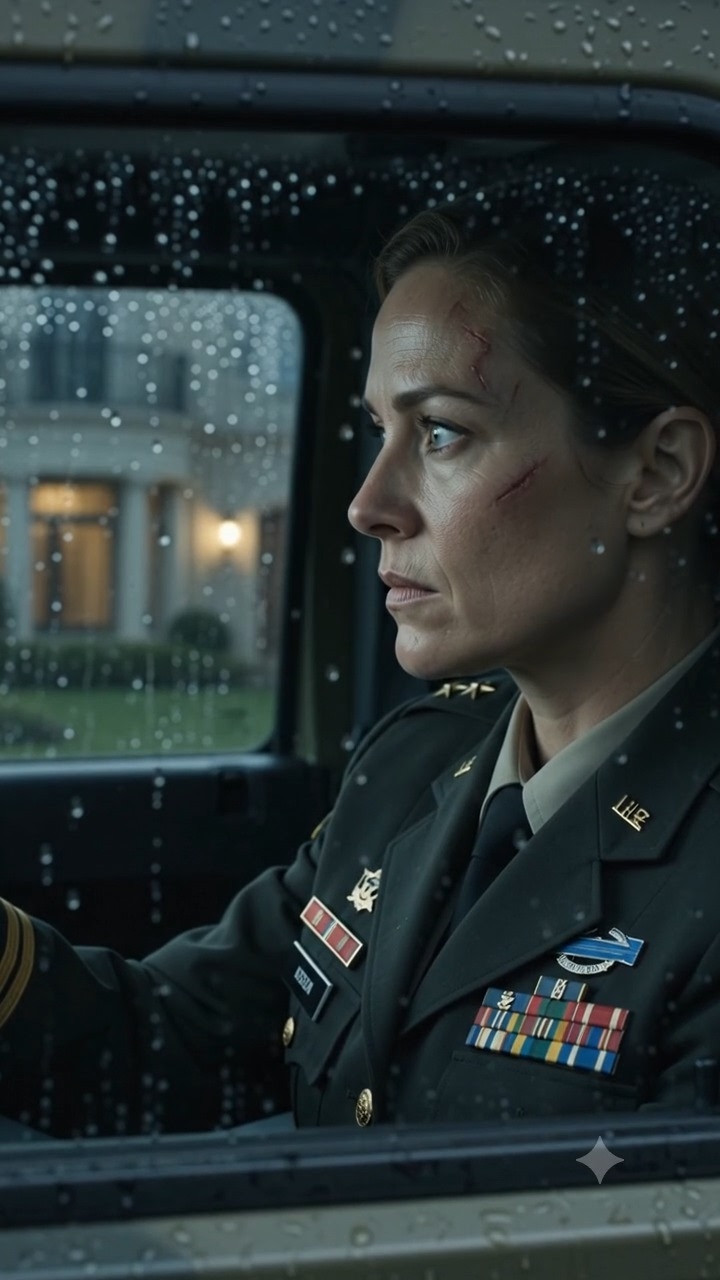
I was wearing my full Army Service Uniform. The dark blue fabric was crisp, the golden buttons gleaming under the studio lights. Across my chest hung my ribbons—the Bronze Star, the Purple Heart, the Army Commendation Medal. For the first time in seven years, I was not hiding the scars on my neck or the faint shadow of trauma beneath my eyes.
“Captain Hart,” Sarah began, her voice echoing through the silent studio. “Three weeks ago, you were in the ICU fighting for your life. Today, your husband faces decades in federal prison, your family’s financial network has completely collapsed, and you stand here as a symbol of unprecedented resilience. What made you break your silence?”
I looked directly into the camera lens, knowing that in a small, cramped rental apartment across town, my parents were watching. Knowing that in a concrete holding cell, Grant was watching.
“For seven years, I believed a lie,” I said, my voice steady, resonant, and unwavering. “I believed that my duty as a wife meant bearing the violence of a broken man. I believed that my duty as a daughter meant letting my family drain my life’s blood to fuel their vanity. I thought that putting up with abuse was a form of toughness.”
I leaned forward slightly, resting my hands on the table.
“I spent twelve years in the United States Army. I fought in wars across the globe. But the hardest war I ever fought was inside my own home, fighting against the belief that I deserved to be destroyed. When my husband slammed my head against that counter and asked if my medals could save me… he was right about one thing. The medals couldn’t save me. But the strength I built to earn them did.”
“Your parents claimed in a recent press statement that you betrayed them,” Sarah noted, her eyes sharp. “They say you abandoned your family in their time of financial need.”
A cold, faint smile touched my lips.
“My parents didn’t want a daughter,” I replied calmly. “They wanted a financial guarantee. They wanted the status that came with my uniform without ever respecting the sacrifice it represented. When I was dying in the ICU, coughing up blood, my mother told me I made my bed. My father told me I was embarrassing the family. They didn’t care if I lived or died—they only cared if the mortgage went through.”
I paused, letting the weight of my words settle over the millions of viewers watching across the country.
“To anyone sitting in the dark right now,” I continued, “wearing long sleeves to hide the marks, convincing yourself that if you just stay quiet, if you just endure a little longer, things will get better… hear me clearly. Loyalty to people who destroy you is not loyalty. It is complicity in your own destruction. Cut the line. Burn the bridge. Reclaim your life.”
The interview ended, but the impact was seismic. Within hours, the video went viral globally. The hashtag #CaptainHart swept across social media platforms. Thousands of victims of domestic abuse began sharing their stories.
The political pressure on the district attorney’s office reached a boiling point. Any lingering hope Grant had of a lenient plea deal evaporated instantly. The public outcry was so severe that the judge revoked his bail entirely, declaring him a flight risk and a danger to society.
Two days later, I received a final letter from my father, delivered through his bankruptcy attorney. It wasn’t an apology. It was a bitter, broken man ranting about how I had ruined his life, how I was dead to him, how he wished I had never returned from Afghanistan.
I didn’t burn the letter. I didn’t cry over it.
I simply folded it up, walked out to the edge of the military post’s firing range, and tossed it into the disposal bin along with the last remnants of my past.
They had thought I was giving up. They had thought I was broken.
They had simply failed to understand that when an officer retreats, it is only to regroup, rearm, and return with overwhelming force.
Orther Post



MEDALS & MAYHEM: THE CAPTAIN'S RECKONING
6
Chapters